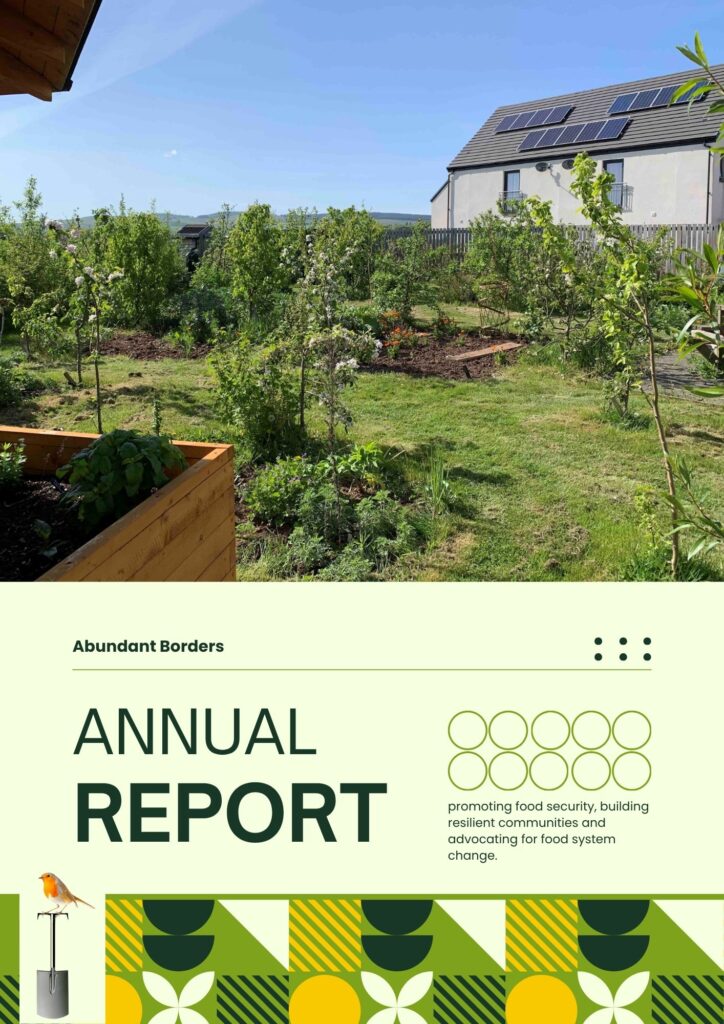
TRUSTEES ANNUAL REPORT
to end March 2025
The trustees present their annual report and financial statements for the year ended 31 March 2025.
The financial statements have been prepared in accordance with the accounting policies set out in note 1 to the financial statements and comply with the charity’s constitution, the Charities and Trustee Investment (Scotland) Act 2005, the Charities Accounts (Scotland) Regulations 2006 (as amended), and “Accounting and Reporting by Charities: Statement of Recommended Practice applicable to charities preparing their accounts in accordance with the Financial Reporting Standard applicable in the UK and Republic of Ireland (FRS 102) (effective 1 January 2019)”.
Objectives and Activities
The charity’s objectives are to promote the advancement of education by training people to produce food in a sustainable and environmentally friendly way. In addition, our activities can reasonably be expected to promote the relief of poverty, specifically household food insecurity, through the development of skills including, but not restricted to, food growing, preservation, and cooking. Environmental protection and improvement are achieved through teaching about biodiversity, soil health, and wildlife-friendly food production. The charity also promotes the use of land for recreational purposes through the creation of community gardens and other growing spaces.
The trustees have paid due regard to guidance issued by the Office of the Scottish Charity Regulator in deciding what activities the charity should undertake.
THE YEAR IN REVIEW
Abundant Borders has continued to deliver high-impact community food growing, cooking, and education projects across the Scottish Borders. Despite ongoing challenges in funding, staffing transitions, and external pressures such as the cost-of-living crisis, the organisation has remained resilient and proactive, increasing its visibility and influence at regional and national levels.
Community Food Growing
Abundant Borders supported community gardens across multiple sites, including Duns, Kelso (Orchard Park and Rodger Fish), Eyemouth, Hawick, Ayton, Foulden, and the new Borders Seed Collective site at Lowood Walled Garden. These gardens provided fresh, healthy food to local communities and food banks and served as inclusive spaces for volunteers and learners.
Despite a poor growing season, the gardens remained productive, with surplus produce distributed via share sheds and community partnerships such as Duns Fair Share, Marchmont House, and the Salvation Army.
The Lowood site was established as the hub for the Borders Seed Collective, focusing on adaptation gardening and landrace seed saving.
Notable events included heritage apple grafting, biodiversity workshops, and cross-site visits to learn biodynamic methods.
Cooking Courses and Food Education
The cookery programme, led by Sabina, remained a cornerstone of Abundant Borders’ work, linking food growing to healthy eating and food security.
Courses included Cook Fresh, air fryer demonstrations, and cooking for employability, often tailored through the SBC No One Left Behind programme.
Sabina gained REHIS approval and began delivering certified food hygiene training, with plans to scale up the service as an income stream.
A 28-page cookery course prospectus was developed to promote workshops to third-sector and public bodies.
Workshops and Events
Abundant Borders delivered and supported a wide range of community workshops, including herbal remedy courses, botanical printing, outdoor cooking, and seasonal food celebrations.
The organisation hosted Joseph Lofthouse, a pioneer in landrace seed saving, and participated in regional events such as the BOG Apple Festival.
Ongoing collaboration with Borders Organic Gardeners supported the development of a regional seed saving network.
Partnership Development and Food System Work
Abundant Borders played a leading role in strategic food system development in the Scottish Borders.
The organisation led the establishment of the Borders Food Forum, which gained Sustainable Food Places membership and will eventually transition to an independent body.
It actively participated in regional food planning processes and contributed to national consultations on the Good Food Nation Act.
Abundant Borders also helped initiate the Farming 2045 Regenerative Agriculture Network, collaborating with local land-based stakeholders.
Funding and Finance
This financial year saw both success and challenges in funding.
Secured multi-year funding included:
- £28,539 per year from the National Lottery Community Fund
- £5,000 per year from the Fallago Trust
- £15,000 from the Robertson Trust
Additional project funding was received from the Royal Society of Edinburgh (RSE) and local trusts.
Abundant Borders developed a new self-generated income stream via consultancy and training.
Financial planning scenarios were introduced to support sustainability, including consideration of staff restructuring and the establishment of stand-alone projects.
Staffing and Governance
The year included significant staffing transitions.
Claire Pencak left her role in the Duns Community Garden and later returned to support the Hawick Community Garden, following Bill’s departure.
Hannah left her role in the Kelso Community Garden, with Carys Dawes recruited to support Kelso and Duns from April 2025.
Pete expanded his role to include garden coordination and finance/admin functions.
Sabina was retained under a short-term contract, with discussions ongoing to support her desire for the food programme to become a stand-alone enterprise.
Karen Birch announced her departure as Chief Officer, with a structured handover period planned through to July 2025.
Board development included welcoming new trustee Steven Walker and efforts to strengthen local representation.
Looking Ahead
With secured funding and a talented team in place, Abundant Borders is well-positioned to build on this year’s work. The upcoming transition in leadership, the potential evolution of the food programme, and the handover of the Borders Food Forum offer both challenges and exciting opportunities to renew and strengthen the organisation’s mission to support food justice and resilience in the Scottish Borders.
Accounts to end March 2025 – can be viewed here
Accounts to end March 2024 can be viewed here
Accounts to end March 2023 can be viewed here
Accounts to end March 2022 can be viewed here
Accounts to end March 2021 can be viewed here
Accounts to end March 2020 can be viewed here
Accounts to end January 2019 can be viewed here.
Please note: Accounts were complied for the period April 2018 to January 2019. At this point Abundant Borders SCO46962 converted to SCIO SCO49008
Accounts to end March 2018 can be viewed here.